

A Genco Method™ White Paper By Tijen Genco, MCC, ACTC, NBC-HWC, MBB
Introduction: Why ROI in Coaching Has Been Misunderstood
Organizations invest in coaching because they want meaningful change—better leadership, healthier cultures, stronger teams, and more resilient enterprises. Yet most ROI conversations remain trapped in behavioral checklists, lagging indicators, or spurious correlations, failing to capture the true value of developmental work.
Coaching is not a transactional service. It is a developmental intervention that shifts:
- How leaders perceive complexity.
- How they regulate emotion.
- How they make meaning.
- How they govern systems.
To measure coaching accurately, we must measure what actually transforms, not just what is easiest to count or what we want to see.
This white paper introduces a developmental, systemic, and evidence-based approach to ROI—grounded in the Genco Method™ and aligned with organizational architecture, Balanced Scorecard logic, and cognitive development science.
1. The Foundations of ROI: What We Measure Shapes What We See
ROI Return on Investment is simply the relationship between value created and resources invested. But in coaching, the question is: What counts as value? And: Are we measuring the right variables?
Balanced Scorecard (BSC) The BSC remains one of the most reliable frameworks for organizational health because it integrates:
- Financial
- Customer
- Internal Process
- Learning & Growth
Coaching impacts all four—but at different developmental tiers.
Probability & Confounders: Organizations often misattribute outcomes to the wrong variable. The classic example: ice cream sales and violent crime rise together—not because one causes the other, but because both rise with temperature.
Coaching ROI suffers from the same trap when:
- Lagging indicators are used to claim causation.
- Behavioral correlations are mistaken for transformation.
- Vertical or multi-dimensional development is ignored.
To measure coaching accurately, we must understand leading indicators and developmental altitude.
2. The Three Developmental Tiers of Coaching
Coaching is not one thing. It operates across three developmental tiers, each with distinct cognitive demands, organizational impact, and measurement logic.
Tier 1 — Transactional Coaching
- Horizontal Development: Focuses on behavior, action, motivation, and values. Change shows up as protocol adoption, not meaning-making shifts.
- Indicators: Faster cycle times, reduced handoff friction, and localized improvements tied to external accountability.
- Sustainability: Low—behavior is externally regulated and regresses under stress.
Tier 2 — Transformational Coaching
- Vertical Development: Focuses on biology, emotions, neurology, and energy. Change shows up as insight, reframing, and emotional regulation.
- Indicators: Improved relational agility, reduction in interpersonal friction, and grounded responses in high-stakes conversations.
- Sustainability: Moderate—insight-driven change is episodic and collapses under acute stress.
Tier 3 — Transcendental Coaching (Genco Method™)
- Multi-Dimensional Development: Focuses on meaning-making, physiology, neurology, energy, and blueprint reconstruction. Change shows up as conscious re-authoring, not reaction or reframing.
- Indicators: Crisis-stable ‘awakened leadership presence™’, high-clarity decision-making, organization-wide coherence, and strategic direction shifts.
- Sustainability: High—change becomes self-generating and influences teams, culture, and ecosystem impact.
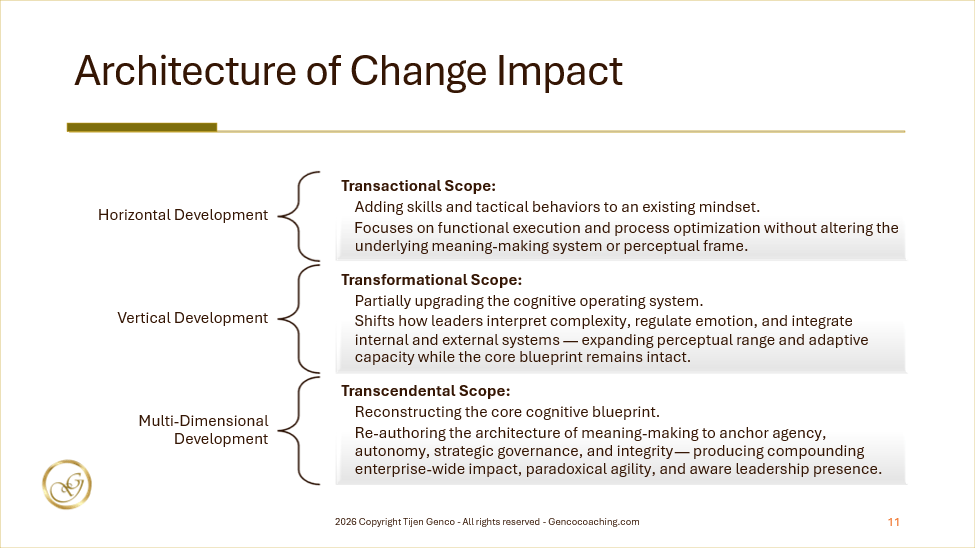
3. The Architecture of Change Impact
- Horizontal Development (Tier 1): Adds skills and behaviors to an existing mindset.
- Vertical Development (Tier 2): Upgrades the cognitive operating system.
- Multi-Dimensional Development (Tier 3): Reconstructs the meaning-making blueprint itself—enabling sovereign governance, paradoxical agility, and compounding enterprise impact.
This architecture is essential for understanding what type of change is possible at each tier—and therefore how to measure it.
4. The Missing Link: Organizational Architecture
Organizations do not transform through isolated behaviors. They transform through nested developmental capacities that scale from the individual to the enterprise.
To measure ROI accurately, coaching tiers must be aligned with:
- Intervention Needs and Strategies
- Initiative Types
- Enterprise Maturity Levels
This alignment prevents mismeasurement and reveals the true systemic value of coaching.
5. Coaching Tier Mapping to Organizational Change Interventions
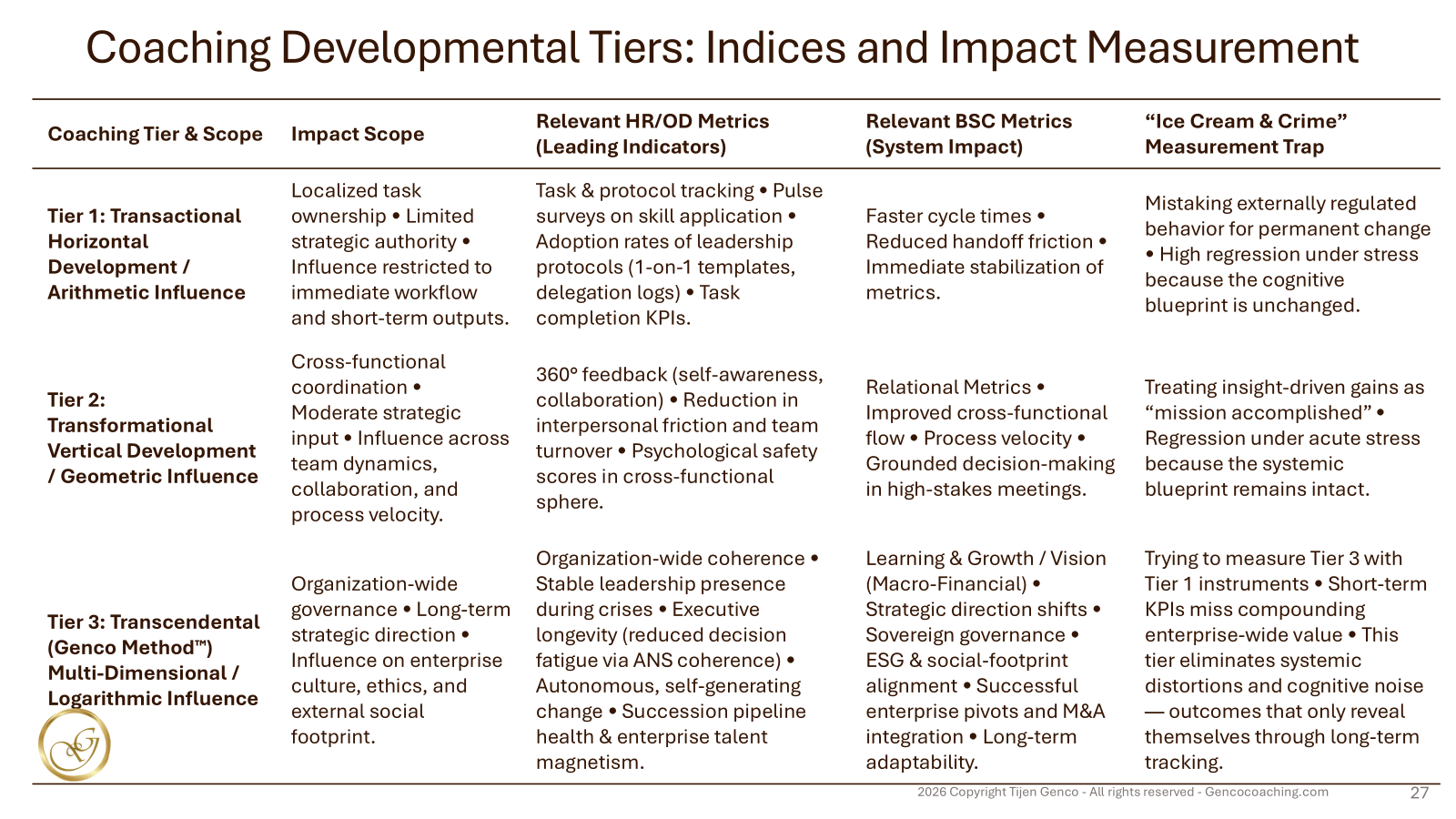
This framework clarifies precisely what type of organizational change each coaching tier can and cannot support.
6. The Integrated Architecture of Coaching, Organizational Change & Enterprise Maturity
| Dimension | Tier 1 — Transactional | Tier 2 — Transformational | Tier 3 — Transcendental (Genco Method™) |
| Coaching Tier | Behavioral execution & protocol adoption | Emotional regulation, reframing, relational agility | Blueprint reconstruction, sovereign governance, systemic coherence |
| Intervention Scope | Operational Stabilization | Relational & Cognitive Optimization | Strategic & Cultural Governance |
| Initiative Type | Individual / Executive Coaching | Team / Departmental Coaching | Organizational / Strategic Coaching |
| Enterprise Maturity | Level 1 — The Baseline (Operational Excellence) | Level 2 — The Accelerator (Service Excellence) | Level 3 — The Multiplier (Systemic Governance) |
| Measurement Alignment | Financial & Internal Process KPIs | Internal Process & Learning Indicators | Learning & Growth / Vision Metrics |
| Measurement Trap | Mistaking action for internal change | Treating insight as completion | Using Tier 1 KPIs to measure systemic value |
This is the north star of the entire ROI model.
7. Enterprise Maturity Levels: Baseline → Accelerator → Multiplier
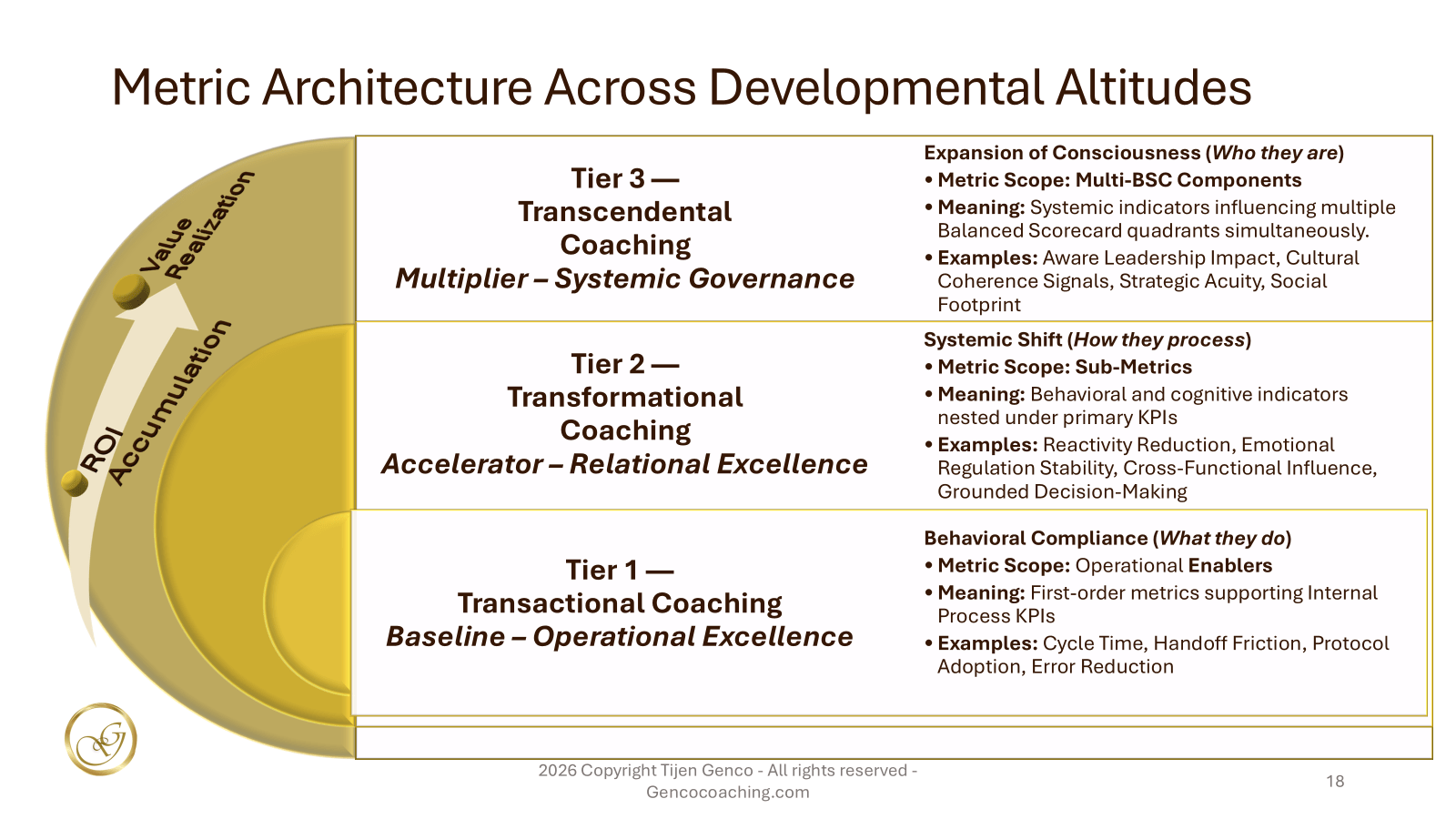
This maturity arc shows how coaching becomes a strategic multiplier at higher altitudes.
8. Conclusion: Measuring What Truly Transforms
Coaching ROI cannot be captured through behavioral checklists or short-term KPIs. It must be measured through:
- Developmental altitude
- Systemic coherence
- Strategic adaptability
- Long-term cultural and governance shifts
Coaching, understood correctly, is not merely a behavioral intervention. It is a developmental, systemic, consciousness-shifting discipline—and it deserves a measurement standard equal to that ambition. The future of coaching ROI must be developmental, systemic, and consciousness-based. Awakening must be the new measure.
The Genco Method™ provides a multi-dimensional, evidence-based framework for understanding and measuring transformation—from individual behavior to enterprise-wide impact.
When organizations measure what truly transforms, coaching becomes not a cost center, but a strategic engine for sustainable, ethical, and regenerative growth.

Key Takeaways: ROI for Coaching
- Traditional ROI metrics fail to measure transformation. Most organizations rely on behavioral checklists and lagging indicators that capture activity, not developmental change.
- Coaching impact occurs at three distinct developmental tiers. Transactional (behavior), Transformational (cognition/emotion), and Transcendental (meaning‑making, sovereignty, systemic coherence).
- Measurement altitude determines accuracy. Self‑reported gains often overestimate impact; systemic, multi‑rater, and longitudinal metrics reveal the true ripple effect.
- Organizational architecture must align with the coaching tier. Misalignment between intervention type, maturity level, and measurement logic creates the “ROI illusion.”
- Enterprise maturity evolves through three levels. Baseline (Operational Excellence), Accelerator (Service Excellence), and Multiplier (Systemic Governance). Coaching becomes exponentially more valuable as organizations ascend these levels.
- Transcendental coaching requires consciousness‑based metrics. Strategic acuity, cultural coherence, ESG alignment, and awakened leadership presence become the new indicators of value.
- Awakening is the future of ROI. Transformation is not behavioral — it is cognitive, somatic, neurological, energetic, and consciousness‑based.
- The Genco Method™ provides a multidimensional measurement framework. It integrates neuro‑cognitive‑somatic development with organizational architecture to capture true systemic transformation.
The Genco Coaching offers an evidence‑based, neuro‑cognitive‑somatic framework for high‑resolution coaching. To explore transformative coach trainings and upcoming programs, visit Coaching Events | Genco Coaching — or our Genco Method© Services – Executive, Life, Wellbeing Coaching – Coach Training, Mentoring and Supervision to inquire about organizational engagements, developmental mentoring, and enterprise‑level coaching solutions.
Tijen Genco, MS, MCC, ACTC, NBCHWC, MBB is a master coach, assessor, and creator of the Genco Method™, a neuro‑cognitive‑somatic framework for high‑resolution coaching. She serves as an educator and developmental architect for coaches and organizations seeking systemic, ethical, and consciousness‑based transformation. Her work advances global coaching standards and supports leaders in cultivating awakened presence, sovereign governance, and regenerative impact.
© 2026 Tijen Genco, Genco Coaching LLC. All rights reserved.
You must be logged in to post a comment.